

Showing posts with label Mahatma Gandhi. Show all posts
Showing posts with label Mahatma Gandhi. Show all posts
Thursday, 4 August 2011


Film Actress Vanishri ,BuddhaPrasad garu
Vanisri or Ratna Kumari (born 3 August 1948), also known as Vanisree or Vanishree, is a popular Telugu actress in the mid 1960s to the late 1970s.
Vanisri was born in Nellore, Andhra Pradesh, India in 1948. Actor S V Ranga Rao gave her screen name Vanisri.
Her first film was Marapurani Kadha. She gained attention with a supporting role in a film penned by K. Balachander titled Sukha Dukhalu, where the famous song "idi mallela velayani" was picturized on her. She became a heroine and held the top spot through most of the 1970s
Vanisri returned to film in the late 1980s acting in mother roles, such as her character in Attaku Yamudu-Ammayiki Mogudu (1989). She was also in the 1999 hindi film Main Tere Pyar Mein Pagal directed by Telugu director K. Raghavendra Rao. She often portrays arrogant mothers-in-law or aunts. Vanisri has acted in television serials as well.
She also worked as politician in Congress party.

Vanisri was born in Nellore, Andhra Pradesh, India in 1948. Actor S V Ranga Rao gave her screen name Vanisri.
Her first film was Marapurani Kadha. She gained attention with a supporting role in a film penned by K. Balachander titled Sukha Dukhalu, where the famous song "idi mallela velayani" was picturized on her. She became a heroine and held the top spot through most of the 1970s
Vanisri returned to film in the late 1980s acting in mother roles, such as her character in Attaku Yamudu-Ammayiki Mogudu (1989). She was also in the 1999 hindi film Main Tere Pyar Mein Pagal directed by Telugu director K. Raghavendra Rao. She often portrays arrogant mothers-in-law or aunts. Vanisri has acted in television serials as well.
She also worked as politician in Congress party.


Vishvayogi Vishwam to sanmanam
Shri Mandali Buddhaprasad being felicitated by His Holiness Bhagwan Sri Sri Sri Viswayogi Viswamjee Maharaj
His Holiness Bhagwan Sri Sri Sri Viswayogi Viswamjee Maharaj is a spiritual humanist who is an embodiment of divine and unconditional love. Universal integration, peace, love, brotherhood, service to needy people and propagation of human values are some of the goals of Bhagwan Sri Sri Sri Viswayogi Viswamjee Maharaj.
His family belongs to Vajasaneya sakha (Yagnavalkya sakha) the same as that in which Sri Narisimha Saraswathi was born, and to Srivatsa gothra hailed from the village of Chamullamudi. He was born in Guntur on March 5, 1944 to Srimathi Varalakshmamma and Sri Anjaneyulu. His father, Sri Gurrapadiya Anjaneyulu was a great practitioner of austerities. Lord datta appeared to him in a dream and gave him initiation with Taraka mantra. He was also a great poet and led a highly disciplined life. Once on some business he had to go to Benares and live there for some days. One night he had a vision in which he noticed beams of light emanating from the Jyotirlinga (the idol of Viwanatha). Since at the same time his wife in Guntur gave birth to a male child, Sri Anjaneyulu named his new-born son Viswanatha Sastri. Everyone, however, used to call the child Viswam.
His Holiness Bhagwan Sri Sri Sri Viswayogi Viswamjee Maharaj is a spiritual humanist who is an embodiment of divine and unconditional love. Universal integration, peace, love, brotherhood, service to needy people and propagation of human values are some of the goals of Bhagwan Sri Sri Sri Viswayogi Viswamjee Maharaj.
His family belongs to Vajasaneya sakha (Yagnavalkya sakha) the same as that in which Sri Narisimha Saraswathi was born, and to Srivatsa gothra hailed from the village of Chamullamudi. He was born in Guntur on March 5, 1944 to Srimathi Varalakshmamma and Sri Anjaneyulu. His father, Sri Gurrapadiya Anjaneyulu was a great practitioner of austerities. Lord datta appeared to him in a dream and gave him initiation with Taraka mantra. He was also a great poet and led a highly disciplined life. Once on some business he had to go to Benares and live there for some days. One night he had a vision in which he noticed beams of light emanating from the Jyotirlinga (the idol of Viwanatha). Since at the same time his wife in Guntur gave birth to a male child, Sri Anjaneyulu named his new-born son Viswanatha Sastri. Everyone, however, used to call the child Viswam.

Wednesday, 3 August 2011

విజయనగర సామ్రాజ్యము Vijayanagara Sāmrājyamu
Birth of The Vijayanagara Empire
(Kannada: ವಿಜಯನಗರ ಸಾಮ್ರಾಜ್ಯ Vijayanagara Sāmrājya, Telugu: విజయనగర సామ్రాజ్యము Vijayanagara Sāmrājyamu), referred as the Kingdom of Bisnaga by the Portuguese, was a South Indian empire based in the Deccan Plateau. Established in 1336 by Harihara I and his brother Bukka Raya I of Yadavas Lineage.The empire rose to prominence as a culmination of attempts by the southern powers against Islamic invasions by the end of the 13th century.[3] It lasted until 1646 although its power declined after a major military defeat in 1565 by the Deccan sultanates. The empire is named after its capital city of Vijayanagara, whose impressive ruins surround modern Hampi, now a World Heritage Site in modern Karnataka, India. The writings of medieval European travelers such as Domingo Paes, Fernão Nunes[4] and Niccolò Da Conti and the literature in local vernaculars provide crucial information about its history. Archaeological excavations at Vijayanagara have revealed the empire's power and wealth.
The empire's legacy includes many monuments spread over South India, the best known being the group at Hampi. The previous temple building traditions in South India came together in the Vijayanagara Architecture style. The mingling of all faiths and vernaculars inspired architectural innovation of Hindu temple construction, first in the Deccan and later in the Dravidian idioms using the local granite. Secular royal structures show the influence of the Northern Deccan Sultanate architecture. Efficient administration and vigorous overseas trade brought new technologies like water management systems for irrigation. The empire's patronage enabled fine arts and literature to reach new heights in the languages of Kannada, Telugu, Tamil and Sanskrit, while Carnatic music evolved into its current form. The Vijayanagara Empire created an epoch in South Indian history that transcended regionalism by promoting Hinduism as a unifying factor.

(Kannada: ವಿಜಯನಗರ ಸಾಮ್ರಾಜ್ಯ Vijayanagara Sāmrājya, Telugu: విజయనగర సామ్రాజ్యము Vijayanagara Sāmrājyamu), referred as the Kingdom of Bisnaga by the Portuguese, was a South Indian empire based in the Deccan Plateau. Established in 1336 by Harihara I and his brother Bukka Raya I of Yadavas Lineage.The empire rose to prominence as a culmination of attempts by the southern powers against Islamic invasions by the end of the 13th century.[3] It lasted until 1646 although its power declined after a major military defeat in 1565 by the Deccan sultanates. The empire is named after its capital city of Vijayanagara, whose impressive ruins surround modern Hampi, now a World Heritage Site in modern Karnataka, India. The writings of medieval European travelers such as Domingo Paes, Fernão Nunes[4] and Niccolò Da Conti and the literature in local vernaculars provide crucial information about its history. Archaeological excavations at Vijayanagara have revealed the empire's power and wealth.
The empire's legacy includes many monuments spread over South India, the best known being the group at Hampi. The previous temple building traditions in South India came together in the Vijayanagara Architecture style. The mingling of all faiths and vernaculars inspired architectural innovation of Hindu temple construction, first in the Deccan and later in the Dravidian idioms using the local granite. Secular royal structures show the influence of the Northern Deccan Sultanate architecture. Efficient administration and vigorous overseas trade brought new technologies like water management systems for irrigation. The empire's patronage enabled fine arts and literature to reach new heights in the languages of Kannada, Telugu, Tamil and Sanskrit, while Carnatic music evolved into its current form. The Vijayanagara Empire created an epoch in South Indian history that transcended regionalism by promoting Hinduism as a unifying factor.
Mooru Rayara Ganda,King of three kings
Śrī Krishna Devarāya (Tulu: ಶ್ರೀ ಕೃಷ್ಣದೇವರಾಯ, Kannada: ಶ್ರೀ ಕೃಷ್ಣದೇವರಾಯ, Telugu:శ్రీ కృష్ణ దేవరాయులు) also known as Krishna Rai in some inscriptions was the famed Emperor of the Vijayanagara Empire who reigned from 1509 - 1529 CE.He is the third ruler of the Tuluva Dynasty. Presiding over the empire at its zenith, he is regarded as an icon by many Indians. Emperor Krishna Deva Raya earned the titles Kannada Rajya Rama Ramana (ಕನ್ನಡರಾಜ್ಯರಮಾರಮಣ), 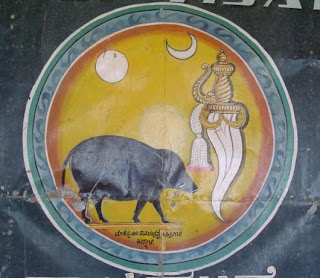

) and Andhra Bhoja (ఆంధ్రభోజ).
Krishna Deva Raya was one of the greatest statesmen which medieval South India had produced. Especially for Telugu people he will remain forever in their hearts as the greatest king ever to rule the Āndhradeśa(Telugu land) as his period is considered as Swarnayuga (Golden period or Zenith) in the cultural and literary history of Telugus. Much information about his reign comes from the accounts of Portuguese travelers Domingo Paes and Fernao Nuniz. Krishna Deva Raya benefited from the able prime minister Timmarusu, who was regarded by the emperor as a father figure and was responsible for his coronation. Krishna Deva Raya was the son of Nagala Devi and Tuluva Narasa Nayaka, an army commander under Saluva Narasimha Deva Raya, who later took control of the empire to prevent its disintegration and became the founder of the Tuluva Dynasty, the third Hindu Dynasty to rule Vijayanagara. The emperor's coronation took place on the birthday of Hindu God Krishna, and his earliest inscription is from July 26, 1509 CE. He built a beautiful suburb near Vijayanagara called Nagalapura in memory of his mother, Nagala.


) and Andhra Bhoja (ఆంధ్రభోజ).
Krishna Deva Raya was one of the greatest statesmen which medieval South India had produced. Especially for Telugu people he will remain forever in their hearts as the greatest king ever to rule the Āndhradeśa(Telugu land) as his period is considered as Swarnayuga (Golden period or Zenith) in the cultural and literary history of Telugus. Much information about his reign comes from the accounts of Portuguese travelers Domingo Paes and Fernao Nuniz. Krishna Deva Raya benefited from the able prime minister Timmarusu, who was regarded by the emperor as a father figure and was responsible for his coronation. Krishna Deva Raya was the son of Nagala Devi and Tuluva Narasa Nayaka, an army commander under Saluva Narasimha Deva Raya, who later took control of the empire to prevent its disintegration and became the founder of the Tuluva Dynasty, the third Hindu Dynasty to rule Vijayanagara. The emperor's coronation took place on the birthday of Hindu God Krishna, and his earliest inscription is from July 26, 1509 CE. He built a beautiful suburb near Vijayanagara called Nagalapura in memory of his mother, Nagala.
Subscribe to:
Posts (Atom)